Wednesday, March 25, 2020

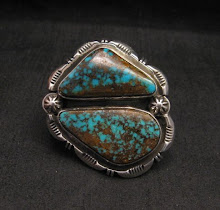
A Farewell to Darryl Becenti - Navajo Silversmith


The Native American jewelry world has lost another incredibly talented artist. It is with a heavy heart that we must inform you that Darryl Becenti passed away this past weekend. Darryl was one of our favorite silversmiths and he was also a sandpainter. He was born in 1957 in Gallup, New Mexico. He was taught silver smithing by his brothers-in-law David and Leroy Reeves. He was also related to Sunshine Reeves, Gary Reeves, and the Cadman family. Darryl used to make his own stamps and dyes, and heavily employed magnificent stars, fans, scallops, shells, and elaborate appliques in all of his jewelry. His jewelry is highly prized for it's deep hand-stamped Navajo designs, repousse silver work, and thick gauge of silver. The Native American jewelry world has lost one of its bright stars. He will be deeply missed.


Your internet source for authentic American Indian jewelry

Digg ThisAdd To Del.icio.us Add To Furl Add To Reddit Fav This With Technorati Add To Yahoo MyWeb Add To Newsvine Add To Google Bookmarks Add To Bloglines Add To Ask Add To Windows Live Add To Slashdot Stumble This

Saturday, March 14, 2020

SANTO DOMINGO DEPRESSION ERA THUNDERBIRD NECKLACES


Here is a nice old traditional Santo Domingo Thunderbird necklace from the 1940's. These necklaces are often referred to as Depression Necklaces. During that era, materials were scarce and so the Santo Domingo indians used whatever materials were available to make these necklace - materials such as broken bakelite shards, gypsum, colored plastic from combs, pails or restaurant spoons and forks, crushed turquoise chips, while old phonograph records or car battery casings were used as the backing material. This set has crushed turquoise insets in each piece of the necklace. These necklaces were sold to tourists along the highway or at RR stops for as little as 1-dollar during the Great Depression. They've become so collectible that they're becoming more and more difficult to come by. If you are collecting these types of Santo Domingo depression folk art necklaces, this one would be a wonderful addition to your collection.

Tumbleweeds Jewelry

Digg ThisAdd To Del.icio.us Add To Furl Add To Reddit Fav This With Technorati Add To Yahoo MyWeb Add To Newsvine Add To Google Bookmarks Add To Bloglines Add To Ask Add To Windows Live Add To Slashdot Stumble This

Wednesday, February 12, 2020

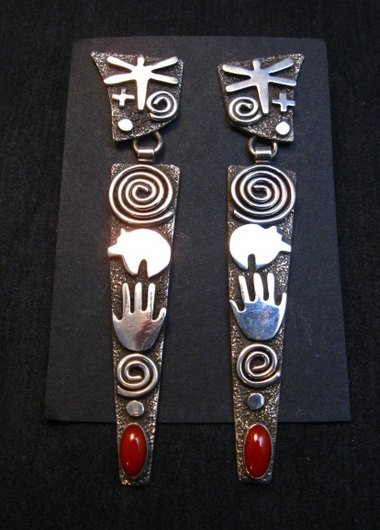
Image 0 of Extra long Navajo Alex Sanchez Petroglyph Coral Silver Earrings

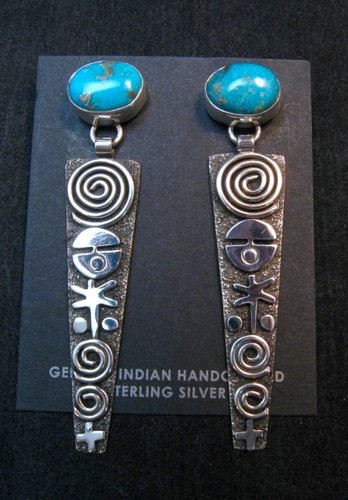
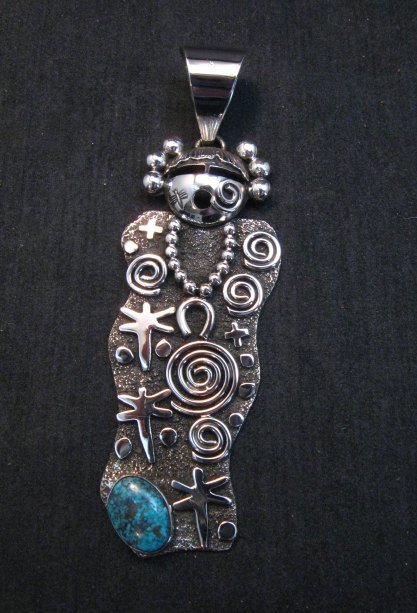
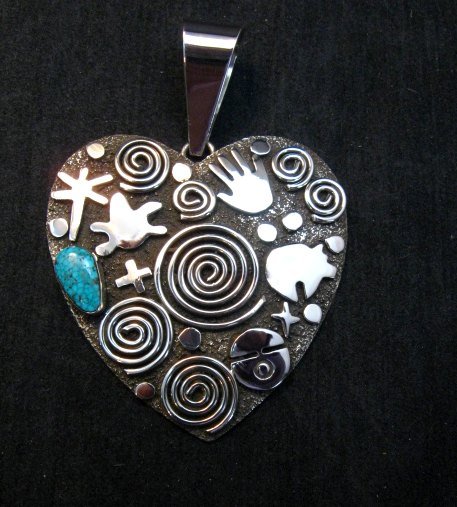
ALEX SANCHEZ JEWELRY


Check out the amazing one of a kind jewelry by Native American silversmith 


Image 0 of Navajo Alex Sanchez Turquoise Silver Petroglyph Earrings
   Image 0 of Extra long Navajo Alex Sanchez Petroglyph Coral Silver Earrings
Image 0 of Navajo Alex Sanchez Maiden Pendant Turquoise Silver    Image 0 of Alex Sanchez Turquoise Heart Pendant, Navajo, Petroglyph                                    

Digg ThisAdd To Del.icio.us Add To Furl Add To Reddit Fav This With Technorati Add To Yahoo MyWeb Add To Newsvine Add To Google Bookmarks Add To Bloglines Add To Ask Add To Windows Live Add To Slashdot Stumble This

Sunday, January 12, 2020

Buy Authentic Native American Indian Jewelry from Reputable Dealers!

This article was copied from the U.S. Department of Justice website.  Just a reminder to buy your Native American Indian jewelry from reputable dealers or from the artists directly! Tumbleweeds Jewelry www.tumbleweedsjewelry.com sells only authentic Native American made jewelry!


JUSTICE NEWS
Department of Justice
Office of Public Affairs
FOR IMMEDIATE RELEASE
Monday, January 6, 2020
Three Defendants Plead Guilty to Conspiring to Fraudulently Sell Imported Jewelry From the Philippines As Native American-Made
Three members of an international conspiracy to import knock-off jewelry from the Philippines and misrepresent it as Native-American have pleaded guilty for their roles in the fraudulent scheme, announced Assistant Attorney General Brian A. Benczkowski of the Justice Department’s Criminal Division and U.S. Attorney Michael Bailey of the District of Arizona. 

On Jan. 6, all three defendants pleaded guilty before U.S. Magistrate Judge John Z. Boyle of the District of Arizona.  Laura Marye Wesley, a.k.a. Laura Lott, 32, pleaded guilty to one count of conspiracy to commit misrepresentation of Indian-produced goods, wire fraud, mail fraud, and entry of goods by means of false statements and smuggling goods, for her role in the manufacture, importation, and sale of knock-off jewelry as Native American-made.  Wesley is scheduled to be sentenced on March 30, 2020.   

Christian Coxon, 46, pleaded guilty to one count of conspiracy to misrepresent Indian-produced goods and to commit wire fraud, for his role in ordering and misrepresenting imported, knock-off jewelry as Native American-made at his retail store Turquoise River Trading Company, located in San Antonio, Texas.  Coxon is scheduled to be sentenced on March 23, 2020.    

Waleed Sarrar, a.k.a. Willie Sarrar, 44, pleaded guilty to one count of conspiracy to misrepresent Indian-produced goods and to commit wire fraud, for his role in ordering and misrepresenting imported, knock-off jewelry as Native American-made at his retail store Scottsdale Jewels, located in Scottsdale, Arizona.  Sarrar is scheduled to be sentenced on March 30, 2020. 

According to information that the defendants admitted to as part of their pleas, from January 2016 through February 2019, they conspired with each other, and others, to design jewelry in the Native-American Indian-style and manufacture the jewelry in the Philippines with Filipino labor.  The defendants also conspired to import the jewelry from the Philippines to Arizona without indelible markings as required by law, and display, advertise, and sell the jewelry to customers based on false representations that the jewelry items were made by Indians in the United States.  To perpetrate the fraud scheme, the defendants and their conspirators communicated by phone, text, and email, including across state and country borders; used private commercial shipping services such as FedEx to import jewelry from the Philippines to the United States; paid for the jewelry inventory through credit cards, including via web-based credit card processors, and by check; and charged the credit cards of customers who purchased the imported Indian-style jewelry. 

As part of her plea, Wesley agreed that she owned and operated LMN Jewelers, a jewelry business that specialized in the sale of Native-American-style jewelry, and co-owned and co-operated Last Chance Jewelers, a similar jewelry business.  She also admitted to removing “Made in the Philippines” stickers from bags of imported jewelry, smuggling jewelry into the U.S. from the Philippines through the U.S. Postal Service to avoid inspection by federal authorities at the port of entry, wiring money to the Philippines to cover the costs of the jewelry-making business there, working with Filipino factory workers who were manufacturing the knock-offs, and delivering the knock-off Native-American-style jewelry to retail jewelry stores in Arizona, Colorado, California, Texas, Minnesota, Utah, and elsewhere.     

The defendants face a maximum penalty of up to five years in prison and fines up to $250,000.  Their sentencing dates have not yet been set.      

The Indian Arts and Crafts Act (IACA) prohibits the offer or display for sale, or the sale of any good in a manner that falsely suggests that it is Indian produced, an Indian product, or the product of a particular Indian and Indian tribe.  The law is designed to prevent products from being marketed as “Indian made,” when the products are not, in fact, made by Indians.  It covers all Indian and Indian-style traditional and contemporary arts and crafts produced after 1935, and broadly applies to the marketing of arts and crafts by any person in the United States.  The IACA provides critical economic benefits for Native American cultural development by recognizing that forgery and fraudulent arts and crafts diminish the livelihood of Native American artists and craftspeople by lowering both market prices and standards.   

This case was investigated by the Office of Law Enforcement for the Southwest Region of the U.S. Fish and Wildlife Service and the Phoenix Field Office of U.S. Immigration and Customs Enforcement’s Homeland Security Investigations, with assistance from the U.S. Department of the Interior Indian Arts and Crafts Board and Office of Law Enforcement and Security, the Arizona Game and Fish Department, the U.S. Forest Service Law Enforcement and Investigations, and the Texas Game Wardens.  Trial Attorney Mona Sahaf of the Criminal Division, Human Rights and Special Prosecutions Section, and Assistant U.S. Attorneys Peter Sexton and Mark Wenker are prosecuting the case.   

Component(s): 
Criminal - Human Rights and Special Prosecution Section
USAO - Arizona
Press Release Number: 
20-02
Updated January 8, 2020

Digg ThisAdd To Del.icio.us Add To Furl Add To Reddit Fav This With Technorati Add To Yahoo MyWeb Add To Newsvine Add To Google Bookmarks Add To Bloglines Add To Ask Add To Windows Live Add To Slashdot Stumble This

Friday, May 4, 2018

MaryTafoya - Santo Domingo Kewa Jewelry Artist


Mary Tafoya, in her own words:

Growing up in a traditional family in Santo Domingo Pueblo, the last thing on my mind was that, my art would allow me to travel to a great part of the United States, much less have my jewelry designs in demand at galleries and art shows!

I have employed skills acquired helping my parents stringing, designing traditional Santo Domingo jewelry. Remember the old style Thunderbird necklaces inlaid on battery casings or records, being sold along highways or on the plaza in Santa Fe? Those are the inspiration for my art.

My jewelry has evolved from traditional Santo Domingo turquoise "heishi" and "Depression Era" work to a modern, contemporary, mosaic, multi-colored inlay jewelry, that is versatile for formal and casual wear. Using natural stones, shells, and turquoise, my designs are free form inlay where no two pieces are alike as each stone, shell or turquoise is cut to fit a design right out of my memory. I try to find different types and colors of stones, unusual shapes of shell, cutting them at different angles to get the desired look. Using different colors of turquoise from different areas of the country or world is not out of the question and can give a necklace or pendant an unusual look. Lately, I have used silver filings to create a "glitter" effect to many pieces. Sometimes I do not know what a piece will look like until it is finished.

My pieces have fooled many of my customers and even seasoned art collectors by asking, "How did you paint these designs?" Until told that these are the natural colors of my material and how they are intricately inlaid, are they amazed in the detail of my work.

I currently live on the Santo Domingo Pueblo with my husband, Lorenzo (also a jeweler/metalsmith) and four children. Our studio, workshop is behind the house and we have had many of our customers tour the facility and we show them the materials, tools, and equipment we use in our work. We love showing people our studio as it gives them the perspective of the work and a deeper appreciation of it.
Start Shopping - See all Mary Tafoya's jewelry


Digg ThisAdd To Del.icio.us Add To Furl Add To Reddit Fav This With Technorati Add To Yahoo MyWeb Add To Newsvine Add To Google Bookmarks Add To Bloglines Add To Ask Add To Windows Live Add To Slashdot Stumble This