Wednesday, March 24, 2010

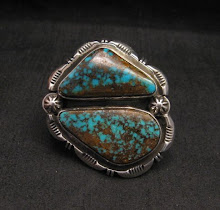
Clayton Tom's Cosmic Bear Pendant


The Cosmic Bear was first introduced by Navajo Calvin Begay and Clayton Tom in the 1990's. The design became so popular, it has been copied again and again by many other Native American artists. But this pendant pictured here is a brand new, original, handmade piece by Clayton Tom, purchased directly from the artist himself. Clayton's jewelry has consistently earned him top awards at major jewelry art shows and Indian markets and led to his recognition as one of the great masters of micro-inlay design and technique. His jewelry is always in big demand, frequently in short supply and often hard to find.


Digg ThisAdd To Del.icio.us Add To Furl Add To Reddit Fav This With Technorati Add To Yahoo MyWeb Add To Newsvine Add To Google Bookmarks Add To Bloglines Add To Ask Add To Windows Live Add To Slashdot Stumble This

Thursday, March 4, 2010

Buying Authentic Native American Jewelry

Here are a few helpful educational websites with information for the Native American Jewelry buyer. The first is a link to a page on the Indian Arts & Crafts Association's website, entitled Tips For Consumers From their website: "IACA is a international not-for-profit trade association established in 1974 to support the ethical promotion and protection of authentic Native American art and culture. IACA works to stop fraud and abuse within the market through education, publicity, authentication and use of our logo to indicate certified ethical businesses. IACA sponsors the largest wholesale trade shows of handmade Indian art in the world twice a year. IACA's membership represents every link in the arts industry – from Native artists from the U.S. and Canada, to collectors, retailers, wholesalers, museums, government agencies, suppliers and other supporters of Native art." I am currently a member in good standing of IACA.

Here is another helpful Native American Jewelry buyers guide prepared by & provided under a cooperative agreement between the Better Business Bureau and the U. S. Federal Trade Commission (FTC). Entitled How to Buy Genuine American Indian Arts & Crafts, this article reinforces how important it is to trust the seller you are purchasing your Native American Indian Jewelry from. Make sure you are dealing with a seller who is informed, educated and who guarantees the authenticity of the jewelry you are buying.

My family has dealt in Native American and other antiquities for over 90 years, and I have specialized in Indian Jewelry for more than 20 years. I am in full compliance with the US Dept. of the Interior American Indian Arts & Crafts Act of 1990. And finally, I am a proud member of the Indian Arts and Crafts Association (IACA). This insures the authenticity of the jewelry I sell and protects your investment.

I make frequent trips to New Mexico and Arizona to hand select the jewelry we offer for sale on our website www.tumbleweedsjewelry.com. I buy directly from many of the artists or I buy through well respected traders who deal directly with the artists. As a member of the Indian Arts & Crafts Association, I attend the annual buyer's markets where I get to meet more artists every year. I enjoy promoting the work of the artists that I have personally met.


Read How to Buy Genuine American Indian Arts & Crafts
or IACA's Tips For Consumers now.

Digg ThisAdd To Del.icio.us Add To Furl Add To Reddit Fav This With Technorati Add To Yahoo MyWeb Add To Newsvine Add To Google Bookmarks Add To Bloglines Add To Ask Add To Windows Live Add To Slashdot Stumble This

Sunday, January 31, 2010

Bracelet Sizing Guidelines - How to determine your bracelet size

Sizing for Cuff Style Bracelets

The best way to get a good fit is to measure a cuff bracelet you already have and compare the inside end-to-end measurement and the gap measurement with the measurements of the bracelet you are considering purchasing.
If you don't have a cuff bracelet to use for comparison, then follow this method:

  • First measure your wrist where you want to wear the bracelet.
  • Then look at the bracelet you are interested in and add: the inside measurement from end to end plus the gap.
  • If the two measurements are fairly close, the bracelet should fit properly. How well it will fit will depend on whether you like to wear your cuff bracelet tight or loose, alone or with other bracelets, in front of or behind the prominent bone on your wrist. Therefore, you may want to add 1/2 inch to 1 inch to the measurement depending upon these variables.
For example, if your wrist measures 7" and you are looking at a bracelet with a 5-3/4" inside circumference and a 1-1/4" gap, then the bracelet will probably fit.

Many cuff bracelets are adjustable. They can be opened or closed up to about a 1/2 inch larger or smaller, depending upon the sturdiness of the bracelet. The types that are not easily adjustable are those that are made from very thick, heavy silver. CAUTION: Bracelets with inlaid stones across the entire front and sides should never be adjusted...at all.

To adjust your bracelet, be very careful how you adjust it so you don't damage it. If you try to bend an area of your bracelet where there is a stone or inlay, the stone may pop out or inlay may crack.

Sizing for Link Style Bracelets
To determine your bracelet size for a link style bracelet: measure your wrist where you want the bracelet to lay for the total length of the bracelet. If you prefer a snug, wrist-hugging fit, use the actual measured circumference of your wrist. If you like a draping, looser fit, increase your measurement by a 1/4" to 3/4" depending on your taste. Keep in mind that larger-link or chunky bracelets may fit more tightly than thin bracelets.

Visit www.tumbleweedsjewelry.com for a great selection of Native American hand made sterling silver bracelets!


Digg ThisAdd To Del.icio.us Add To Furl Add To Reddit Fav This With Technorati Add To Yahoo MyWeb Add To Newsvine Add To Google Bookmarks Add To Bloglines Add To Ask Add To Windows Live Add To Slashdot Stumble This

Friday, November 6, 2009

How to Care for your Native American Jewelry

Follow these tips to keep your Native American jewelry in excellent condition and looking its best for years!

CARE OF STERLING SILVER JEWELRY

Sterling Silver is actually somewhat soft and easily scratched if mishandled. One of the best and simplest way to care for sterling silver jewelry is to use silver polishing cloths that have been specially designed and treated for the purpose of cleaning sterling silver jewelry. These cloths are made of a felt-like material and are impregnated with special non-scratch micro-abrasives. You just rub the surface to be polished with medium pressure to remove tarnish and even light surface scratches. We recommend a cloth like the Sunshine Polishing Cloth, which we sell on our website.
We usually recommend that silver cleaning solutions, cleaners or creams not be used to clean Native American silver jewelry. Many pieces are set with stonework, and if the solutions are used, the stones can be damaged or the color of the stones may change. Many pieces are made with a technique in which the piece was intentionally blackened in strategic areas of the jewelry to provide design definition. Creams can settle in creases of jewelry and can not be removed without damage to the piece.
Special care should also be used when cleaning Hopi jewelry. DO NOT dip Hopi jewelry in any type of liquid silver polishing cleaner, nor should you use any other type of chemical silver polishing cleaner or solution because you will ruin the dark recessed oxidized areas. And hence the contrast of the design and the essence of Hopi jewelry will be lost. Use only a silver polishing cloth like the ones we sell and AVOID rubbing the dark recessed oxidized areas.
Keeping your sterling silver in the open air for extended periods of time without wearing it may cause it to tarnish. To prevent silver from tarnishing, place jewelry in a sealable plastic bag; for added protection, include an anti-tarnish strip. An important exception to this rule relates to jewelry that has been intentionally oxidized or antiqued, as part of the design. This type of jewelry should not be stored in airtight plastic bags, so simply punch a hole in the plastic bag.

CARE OF TURQUOISE JEWELRY

Turquoise is a beautiful stone that is porous so use caution when caring for and cleaning turquoise jewelry. Protect turquoise from prolonged sun exposure, extreme temperatures, cosmetics, perfumes, skin oils, grease, or any other harsh chemicals, as they might discolor the stone. When cleaning turquoise jewelry, use a very soft brush or a slightly damp soft cloth. Do not submerge turquoise in water and avoid using commercial jewelry cleaners, ultrasonic cleaners, chemicals or even soap. A polishing cloth is another safe way to clean or polish turquoise.
Remove jewelry before performing gardening, household tasks or any strenuous activity. Dirt can get into stone settings and scratching of surfaces is possible.

CARE OF INLAY JEWELRY

Remember to treat the inlay jewelry with extra care. Avoid dropping, banging or scratching inlay jewelry. Do not wash with soap and water. And, again, avoid using commercial jewelry cleaners, ultrasonic cleaners or chemicals to clean inlay jewelry. Instead, use polishing cloths to shine or clean inlay jewelry.
Do not attempt to reshape or bend a bracelet, necklace, ring or pendant with inlay or channel work. Do not re-size rings with channel or inlay work. Changing the shape of the underlying metal can loosen the stones. They can actually pop out while the item is being bent and/or the integrity of the setting can be compromised, so that the stones may fall out later on, without being noticed.

SUNSHINE POLISHING CLOTH - Jewelry cleaner - Safely cleans N/A silver jewelry


Digg ThisAdd To Del.icio.us Add To Furl Add To Reddit Fav This With Technorati Add To Yahoo MyWeb Add To Newsvine Add To Google Bookmarks Add To Bloglines Add To Ask Add To Windows Live Add To Slashdot Stumble This

Monday, October 19, 2009

Books about Native American Jewelry

I love sitting down with a good book about Native American jewelry, especially one with lots of color pictures! There are many wonderful books out there about Native American Jewelry. I have selected a few of our favorites below. You are welcome to add your favorite in the comments section below the post.

There are several very helpful books about Native American Jewelry Hallmarks. The one I use most often is "Hallmarks of the Southwest" by Barton Wright, which is available from Amazon. It's a little expensive so it is only worth the price if you are a collector or buyer of Native American Jewelry and think you may be using it frequently. Another helpful book for researching hallmarks on Hopi jewelry is called "Hopi Silver - The History and Hallmarks of Hopi Silversmithing" by Margaret Nickelson Wright. And for Zuni jewelry, I find the book "Zuni Jewelry" by Theda and Michael Bassman very useful. Some of these books are in their second printing, so look for the newest & most recent editions. They are all available on Amazon. Using these three books, you have a good chance of finding the hallmark, especially if the jewelry is older. But of course, these books don't reference the hallmarks of every Native American artist out there..only the more prolific ones.

If you have a specific question about the hallmark on a single or particular piece of jewelry, I might be able to help you. Email me pictures of the piece (front and back) with any other information you may have and I'll quickly research the hallmark for you. I'm not guaranteeing anything but I'm willing to give it a shot!


Digg ThisAdd To Del.icio.us Add To Furl Add To Reddit Fav This With Technorati Add To Yahoo MyWeb Add To Newsvine Add To Google Bookmarks Add To Bloglines Add To Ask Add To Windows Live Add To Slashdot Stumble This